
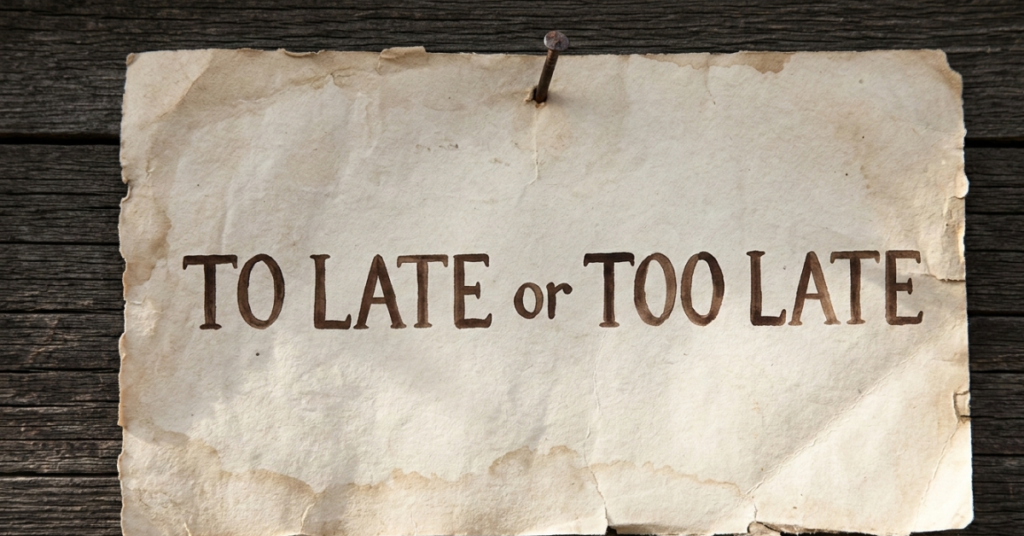

Have you ever stopped mid-sentence and wondered whether you should write to late or too late? It’s a small difference, but one that trips up many English writers. The confusion happens because the words to and too sound exactly the same when spoken.
However, when it comes to grammar, only one version is correct. Understanding the difference between these two spellings will help you avoid a very common writing mistake and improve the clarity of your sentences.
In this guide, we’ll explain the correct usage, explore why the mistake happens, and share simple tricks to remember the rule.
Which Phrase Is Correct?
Let’s clear up the confusion right away.
Correct: too late
Incorrect: to late
The correct phrase is too late because the word too means excessively or beyond the proper time. When something happens after the right moment, we describe it as being too late.
Example Sentences
-
We arrived too late to catch the bus.
-
It’s too late to change the reservation.
-
She realized too late that she forgot her phone.
In each example, the phrase describes something happening after the appropriate time.
What Does “Too” Mean?
The word too functions as an adverb and typically has two meanings in English.
1. More Than Necessary
This meaning describes something excessive or beyond a reasonable limit.
Examples:
-
The room is too cold.
-
The bag is too heavy.
-
The meeting started too late.
2. Also or As Well
Sometimes too means in addition.
Examples:
-
I want to come too.
-
She likes coffee too.
In the phrase we’re discussing, the first meaning applies—something happening later than it should.
What Does “To” Mean?
The word to serves completely different grammatical purposes. It usually acts as either a preposition or part of an infinitive verb.
Common Uses of “To”
1. Showing direction
-
We walked to the park.
-
She drove to the office.
2. Forming infinitive verbs
-
I want to learn Spanish.
-
They plan to travel next year.
Because to does not express excess or timing, combining it with “late” creates a grammatical error.
Why People Make This Mistake
Many writers accidentally choose the wrong spelling because the words to and too sound identical. When typing quickly, it’s easy to pick the shorter version without thinking.
Other reasons include:
-
Autocorrect mistakes
-
Fast typing or texting
-
Lack of familiarity with grammar rules
-
Pronunciation similarities in spoken English
Fortunately, the rule is simple once you understand it.
An Easy Trick to Remember the Difference
A helpful way to remember the correct spelling is to focus on the extra letter.
Too has an extra “O.”
That extra letter represents something extra or excessive.
So whenever you want to describe something beyond the right amount or the right time, choose too.
Examples:
-
too expensive
-
too far
-
too early
-
too late
This quick trick helps many people avoid the mistake instantly.
Situations Where “Too Late” Is Commonly Used
This phrase appears frequently in everyday conversations and writing. Here are some common contexts.
1. Missed Opportunities
-
By the time we arrived, it was already too late.
-
He apologized, but the moment had passed.
2. Deadlines
-
The application was submitted too late.
-
It’s impossible to register now because the deadline passed.
3. Realizations
-
She realized too late that the email had the wrong attachment.
-
They discovered the error too late to fix it.
In each situation, the phrase signals that something happened after the ideal time.
Other Similar Grammar Mistakes
The confusion between to and too shows up in other phrases as well. Here are some common examples.
| Incorrect | Correct |
| to much | too much |
| to many | too many |
| to fast | too fast |
| to difficult | too difficult |