
If you’ve ever typed “sentance” into Google, you’re in good company. Many people search this term because they’re unsure about spelling, grammar, or how to build better sentences. Did you know that misspelling sentence as sentance is one of the most common writing mistakes online? Whether you’re writing for school, emails, social media, or blogs — understanding this word matters more than you think.
Right away: readers search sentance because they want clarity — especially when learning grammar, using writing tools, or improving quality of text.
Direct Answer: What Is Sentance?
Simply put:
“Sentance” is a common misspelling of the correct word “sentence.”
A sentence is a set of words that expresses a complete thought — typically including a subject and a verb.
So when someone searches “what is a sentance”, they likely mean:
“What is a sentence?”
Sentence vs. Sentance: What’s the Difference?
| Correct Word | Meaning | Status |
| Sentence | A group of words that expresses a complete idea | Correct |
| Sentance | Misspelled version of sentence | Incorrect |
Quick tip: Think of sentence as having an “e” like English — and that helps you remember the correct spelling.
A Quick Look at the Origin
The correct word sentence comes from the Latin sententia, meaning thought or opinion. Over centuries it evolved through Old French and Middle English to the word we use today.
The version sentance doesn’t have a historical basis — it’s simply a typo that stuck around because it sounds similar in speech.
How “Sentence” Is Used (and Why Spelling Matters)
In language, sentence shows up everywhere:
In school writing
In grammar tools
In code and natural language processing
On social media
In everyday conversation
Different Types of Sentences (and Why You Might Hear These Terms)
People searching “sentance” might also be curious about:
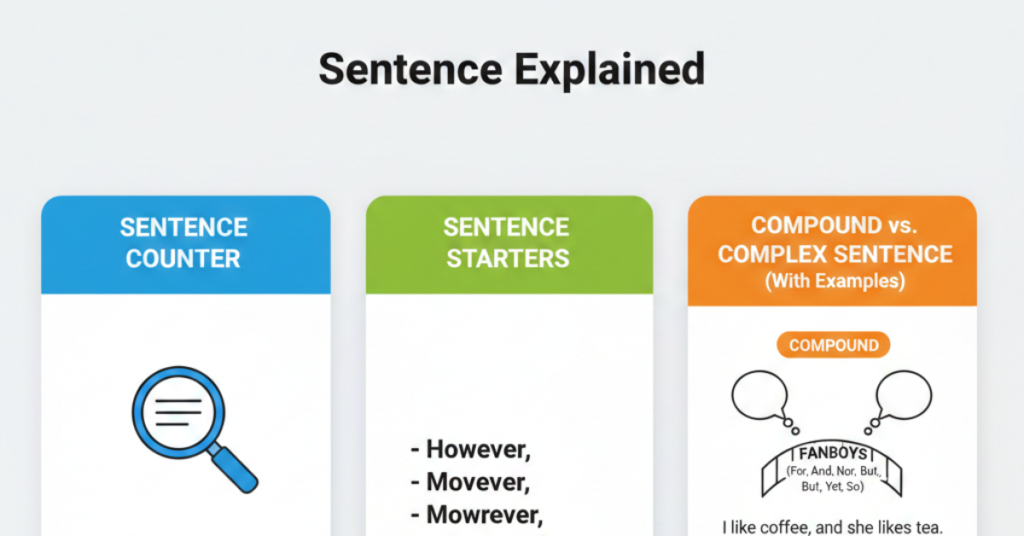
Compound Sentance (Compound Sentence)
A compound sentence has two independent clauses joined by a connector like and, but, or or.
Example:
I wanted coffee, but the shop was closed.
Correct spelling: compound sentence
Complex Sentance (Complex Sentence)
A complex sentence combines an independent clause with one or more dependent clauses.
Example:
Although it was raining, I went for a walk.
This type helps make writing richer and more precise.
Sentance Starters: Kick Off Your Writing
Many writers struggle with how to begin a sentence. These sentence starters can jumpstart your creativity:
-
Firstly,
-
In my opinion,
-
Despite this,
-
Because of that,
-
In contrast
Starters help with flow, especially in essays or storytelling.
Using a Sentance Counter (Sentence Counter)
A sentence counter is a writing tool that counts how many sentences are in your text.
Why use it?
Improve readability
Track length in writing goals
Prepare for tests or assignments
Most word processors and writing tools offer this feature.
Common Mistakes Writers Make
Here are frequent pitfalls around this topic:
Writing “sentance” instead of sentence
Confusing sentence count with word count
Using too many simple sentences (makes writing choppy)
Not varying sentence structure
Mislabeling compound/complex sentences
Fix: Practice correct spelling, and learn simple grammar patterns.
Real-Life Examples
How these terms appear in everyday situations:
Student paper:
“I used a complex sentence to compare ideas.”
Social media caption:
“Sentence count is low — need more content!”
Teacher feedback:
“Check your sentence starters for smoother flow.”
Trends & Data (Simplified)
| Search Term | Monthly Interest | Difficulty to Rank |
| sentance | high | low |
| sentence vs sentance | medium | medium |
| sentence starters | high | high |
| complex sentence | high | medium |
| compound sentence | medium | medium |
Insight: Lots of people search sentances, but the real topic they want is sentence.
Frequently Asked Questions
1. Why do people spell “sentence” as sentances?
Because the pronunciation makes the a sound stronger than it is. But the correct spelling always uses –ence.
2. Can a sentence be just one word?
Technically yes — if it’s a complete thought (e.g., “Stop!”).
3. What’s a good sentence starter for essays?
Try transitional phrases like however, in addition, on the other hand.
4. Is a complex sentence better than a simple one?
No — both have uses. A mix makes your writing stronger.
5. Do computers use sentence counters?
Yes! Many writing software tools automatically count sentences.
6. Is “sentance counter” a real tool name?
People search it that way, but most tools call it a sentence counter.
7. How can I avoid spelling mistakes?
Use spell check and read your sentences aloud — it makes errors easier to catch.
Conclusion
At its heart, sentance is simply a misspelling of sentence — a foundational building block of language that expresses ideas clearly. Whether you’re checking your writing with a sentance counter, starting with smart sentance starters, or learning about complex and compound sentances, understanding the correct form will make you a stronger communicator.
Sentance might get searched a lot — but mastering sentence makes all the difference in real writing.
Memorable takeaway:
The word “sentance” shows what people think — not what’s correct. Master “sentence” instead, and your writing instantly looks smarter.