
If you’ve ever paused mid-sentence wondering whether to write planning or planing, you’re not alone. This is one of those sneaky English word pairs where a single letter completely changes the meaning—and autocorrect isn’t always your friend. Let’s clear it up once and for all, with real examples you’ll actually remember.
The Clear Answer (Read This First)
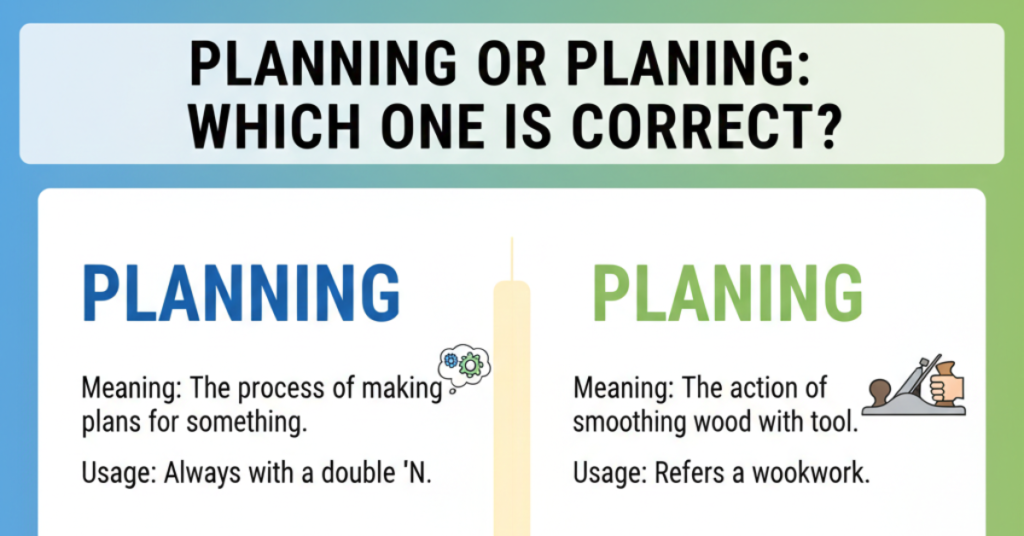
Planning is correct most of the time.
-
Planning = organizing, preparing, or deciding in advance
-
Planing = smoothing or shaping a surface (usually wood) with a tool called a plane
If you’re talking about goals, schedules, events, business, travel, or life in general—planning is your word.
Why People Confuse “Planning” and “Planing”
English loves throwing curveballs, and this one comes from how verbs behave when adding -ing.
-
Plan → double the consonant → planning
-
Plane → drop the “e” → planing
They look similar, sound similar, but live in totally different worlds.
Origins & Background
Understanding where these words come from makes them much easier to remember.
| Word | Origin | Original Meaning |
| Planning | Old French plan | A design or intention |
| Planing | Latin planus | Flat or level |
So historically speaking:
-
Planning has always been about ideas and preparation
-
Planing has always been about physical flatness
Contextual Usage: Abstract vs Physical
Here’s the easiest way to separate them in your head.
Planning (Abstract / Mental)
Used for thoughts, decisions, and future actions.
Examples:
-
Planning a vacation
-
Planning a marketing campaign
-
Planning your career path
Planing (Physical / Manual)
Used for hands-on, physical work—especially woodworking.
Examples:
-
Planing a wooden board
-
Planing rough edges smooth
-
Planing timber for furniture
If it doesn’t involve sawdust or tools, it’s probably planning.
Regional Usage (US, UK & Global)
Good news here—there’s no regional spelling difference.
-
US English: planning / planing
-
UK English: planning / planing
-
Global English: same meanings everywhere
Confusion exists worldwide, but the rules don’t change.
Common Mistakes to Avoid
These are the errors people make most often:
-
I’m planing my wedding next year.
-
We are planing a new business strategy.
-
She spent months planing her goals.
Why they’re wrong: none of these involve a physical surface.
Correct Usage Examples (Real-Life Scenarios)
Training & Education
-
Planning lessons ahead of time improves teaching quality.
Social Media
-
Currently planning content for next month—any ideas?
Everyday Conversation
-
We’re planning a surprise party this weekend.
Woodworking
-
He’s planing the tabletop to remove rough spots.
Usage Trends & Frequency
Here’s how often each word appears in everyday English:
| Word | Usage Frequency | Common Contexts |
| Planning | Extremely High | Business, education, life, goals |
| Planing | Very Low | Carpentry, woodworking, DIY |
In online writing, planning appears thousands of times more often than planing.
Frequently Asked Questions
1. Is “planing” ever correct?
Yes—when referring to smoothing or shaping a surface, especially wood.
2. Why does “planning” have double “n”?
Because “plan” follows a spelling rule: short vowel + consonant → double the consonant before adding -ing.
3. Can “planing” be used metaphorically?
Rarely. In specialized contexts, it might imply leveling something, but this is uncommon and often unclear.
4. Is “planning” a noun or a verb?
Both.
-
Verb: I am planning a trip.
-
Noun: Good planning saves time.
5. Does autocorrect catch this mistake?
Not always. Both are real words, so spellcheck may miss the error.
6. What’s an easy memory trick?
If it involves thinking, use planning.
If it involves tools, use planing.
Final Takeaway
Planning or planing is a classic English confusion, but once you link planning to thinking and planing to tools, it becomes effortless. Planning dominates everyday language, while planing stays tucked away in workshops and sawdust-filled spaces.