
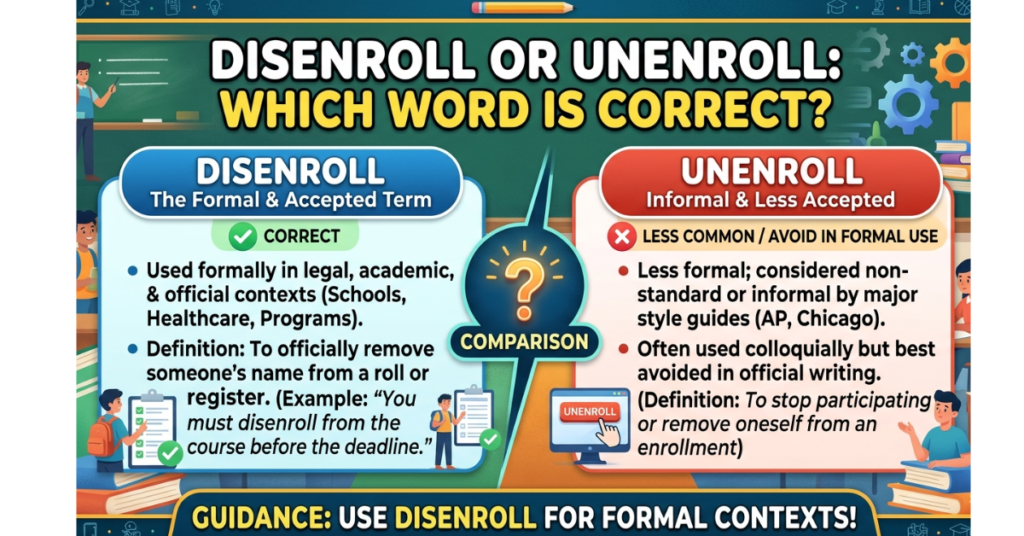

Language can be tricky, especially when two words seem to mean the same thing. One common question people search online is “disenroll or unenroll — which one is correct?” If you’ve ever needed to disenroll or unenroll from school, a course, or a program, you may have noticed both words being used interchangeably.
So which one should you use? Are they both correct? And is there a difference between them?
In simple terms, both “disenroll” and “unenroll” mean to remove someone from enrollment in a school, course, program, or membership list. However, one is considered slightly more standard in formal usage. In this guide, we’ll break down the meaning, correct usage, grammar rules, and examples so you know exactly when to use each word.
What Does Disenroll or Unenroll Mean?
Both disenroll and unenroll describe the action of removing someone from an enrolled status. This could apply to:
-
Leaving a school or college
-
Canceling a course registration
-
Removing membership from a program
-
Ending participation in a service
In most dictionaries, “disenroll” is the more widely accepted and standard form, while “unenroll” is an alternative spelling used in some regions and contexts.
Simple Definition
-
Disenroll: To remove someone from enrollment in a school or program.
-
Unenroll: An alternative form meaning the same thing—cancel or withdraw enrollment.
Although they mean the same thing, disenroll is generally more common in formal writing, especially in educational or administrative documents.
Is It Disenroll or Unenroll?
The short answer: Both are technically correct, but “disenroll” is more commonly preferred.
Many dictionaries and style guides list “disenroll” as the primary term, while “unenroll” appears as a variant spelling.
Why Two Versions Exist
English often allows multiple prefixes that create similar meanings. In this case:
-
Dis- means remove, reverse, or take away
-
Un- means not or reverse an action
Both prefixes logically work with the word enroll, which is why both terms exist.
Usage Preference
Most educational institutions and official documents use:
Disenroll
Examples:
-
The university will disenroll students who fail to pay tuition.
-
You must submit a form to disenroll from school.
However, some online systems or informal writing may still use unenroll.
Disenroll or Unenroll From School
One of the most common searches online is “disenroll or unenroll from school.”
In educational settings, the correct and most commonly used phrase is:
Disenroll from school
What It Means
To disenroll from school means that a student officially withdraws or is removed from enrollment at an educational institution.
This can happen for several reasons:
-
Transferring to another school
-
Taking a leave of absence
-
Dropping out
-
Administrative removal
-
Failing to meet requirements
Example Sentences
-
She decided to disenroll from school and pursue a different career path.
-
The administration may disenroll students who violate academic policies.
-
Parents can request to disenroll their child from a school district.
While “unenroll from school” may appear in conversation, most official forms use disenroll.
Disenroll vs Unenroll: Key Differences
Although the meaning is almost identical, there are small differences in usage.
| Feature | Disenroll | Unenroll |
| Meaning | Remove from enrollment | Remove from enrollment |
| Formal Usage | More common | Less common |
| Dictionary Status | Standard term | Variant spelling |
| Used by Institutions | Yes (most common) | Rare |
Bottom Line
If you’re unsure which to use, choose “disenroll.” It’s the safer and more widely accepted option.
Situations Where Disenroll Is Used
You might encounter the word disenroll in several real-life situations.
1. School or University Withdrawal
Students may disenroll when:
-
Moving to another institution
-
Changing education plans
-
Taking a break from studies
Example:
Students must complete a withdrawal form to disenroll from the university.
2. Online Courses
Many learning platforms allow users to disenroll from courses.
Example:
-
You can disenroll from the course through your dashboard settings.
3. Government or Healthcare Programs
The term also appears in programs such as:
-
Medicare
-
Insurance plans
-
Training programs
Example:
Participants may disenroll from the program during the open enrollment period.
How to Disenroll From a School or Program
If you need to disenroll from school or a program, the process usually follows these steps.
Step-by-Step Process
-
Contact the institution
Speak with the admissions office or registrar. -
Submit a withdrawal request
Many schools require a formal form. -
Clear financial obligations
Ensure tuition or fees are settled. -
Confirm disenrollment
Request written confirmation that your enrollment has ended.
Different schools may have slightly different procedures, so it’s always best to check the official website.
Common Grammar Questions
Is Disenroll a Real Word?
Yes. Disenroll is a recognized word in major English dictionaries and widely used in academic and administrative contexts.
Why Do Some People Say Unenroll?
Because “un-” is a common English prefix used to reverse actions, some speakers naturally form the word unenroll even though disenroll is the more accepted term.
FAQs
1. Is it disenroll or unenroll?
Both words exist and mean the same thing. However, disenroll is the more widely accepted and commonly used term, especially in formal writing.
2. What does disenroll mean?
Disenroll means to remove someone from enrollment in a school, course, program, or membership list.
3. Can you say unenroll from school?
Yes, people sometimes say unenroll from school, but disenroll from school is the more standard and commonly used phrase.
4. Is disenroll the correct spelling?
Yes. Disenroll is considered the standard spelling, while unenroll is a less common variant.
5. How do I disenroll from school?
To disenroll from school, you typically need to:
-
Contact the registrar or administration
-
Submit a withdrawal form
-
Complete any required procedures
-
Receive confirmation of your withdrawal
Conclusion
The debate between disenroll or unenroll is less about correctness and more about preference and usage. Both words technically mean the same thing—to remove someone from enrollment in a school, course, or program.
However, “disenroll” is the term most institutions, dictionaries, and formal documents prefer. If you’re writing professionally or filling out official forms, it’s usually the better choice.