
Clutz or klutz is a question people search because both spellings appear everywhere—books, social media, subtitles, and everyday conversation. If you’ve ever paused mid-sentence wondering which one is “right,” you’re not alone. English has a habit of borrowing words and keeping multiple spellings alive just long enough to confuse everyone.
This guide clears it all up—cleanly, confidently, and without grammar guilt.
The Short, Clear Answer (No Guessing Needed)
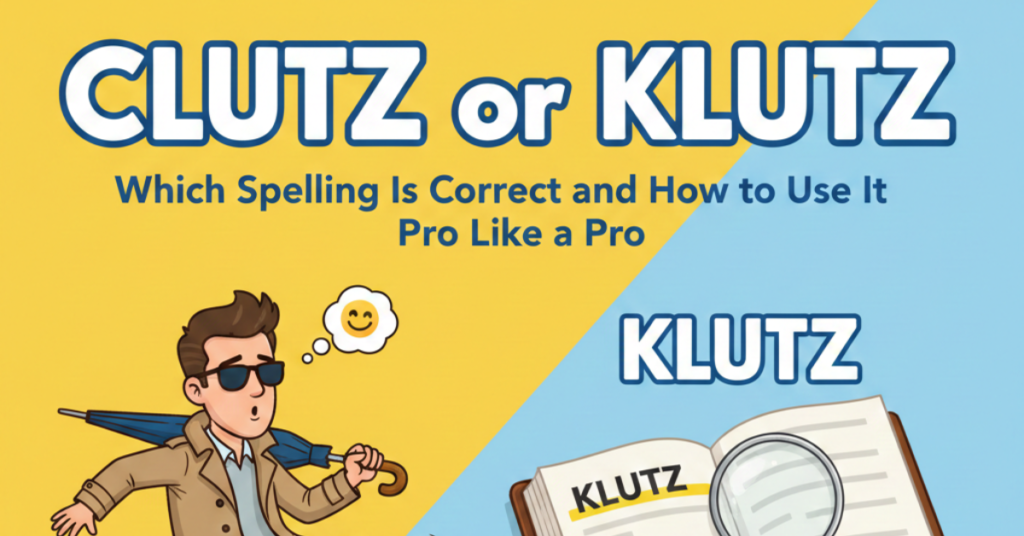
Klutz is the original and correct spelling.
Clutz is an accepted variant, especially common in informal American English.
If you’re writing formally, academically, or professionally:
Use klutz.
If you’re chatting, texting, or posting casually:
Clutz won’t raise eyebrows.
Where Did “Klutz” Come From?
The word klutz comes from Yiddish, derived from klots, meaning:
“A clumsy person” or literally “a block of wood”
Yiddish heavily influenced American English in the late 19th and early 20th centuries, especially through immigrant communities. When klutz entered English, it kept its original spelling—but English speakers eventually softened it to clutz, since “kl” at the start of words feels unusual in English.
That’s how both versions survived.
What Does “Clutz / Klutz” Actually Mean?
At its core, the word describes physical clumsiness—but it’s evolved.
Physical Usage (Most Common)
Someone who:
-
Trips easily
-
Drops things
-
Knocks stuff over
-
Has questionable coordination
Example:
“I spilled coffee on myself again. I’m such a klutz.”
Metaphorical Usage (Modern & Growing)
Someone who:
-
Handles social situations awkwardly
-
Makes repeated careless mistakes
-
Fumbles emotionally or professionally
Example:
“I tried to apologize and somehow made it worse. Total social clutz.”
Regional & Cultural Usage
Here’s how the spellings shake out geographically:
| Region | Preferred Spelling | Notes |
| United States | Klutz (formal), Clutz (casual) | Both widely understood |
| United Kingdom | Klutz | Less common overall |
| Canada | Klutz | Follows US formal usage |
| Australia | Klutz | Rare but recognized |
| Global English | Klutz | Seen in dictionaries |
Bottom line: Klutz is globally safer.
Common Mistakes People Make
Even confident writers slip up here. Watch for these:
-
Assuming clutz is “wrong” (it’s not)
-
Using clutz in academic or professional writing
-
Thinking the two words have different meanings (they don’t)
-
Overthinking it in casual conversation
Pro tip: If spellcheck suggests klutz, trust it.
Real-Life Examples You’ll Recognize
Everyday Conversation
“Don’t hand me the glassware—I’m a klutz.”
Workplace Humor
“I sent the email before attaching the file. Office clutz moment.”
Social Media
“Day 3 of the gym and I tripped over the treadmill klutzlife”
Training & Coaching
“Coordination improves with practice—don’t label yourself a klutz forever.”
Usage Trends: Clutz vs Klutz
Search and usage data shows something interesting:
| Context | More Common |
| Dictionaries | Klutz |
| Books & Journalism | Klutz |
| Social Media | Clutz |
| Text Messages | Clutz |
| Professional Writing | Klutz |
Language evolves—but standards still matter depending on context.
Frequently Asked Questions
1. Is “clutz” incorrect?
No. It’s a recognized variant, just less formal.
2. Which spelling do dictionaries prefer?
Most major dictionaries list klutz as the primary entry.
3. Can I use “clutz” in school assignments?
It’s safer to use klutz, especially in graded or academic work.
4. Do clutz and klutz mean different things?
No—same meaning, different spellings.
5. Is the word offensive?
Generally no. It’s lighthearted and often self-referential, but tone matters.
6. Is it okay to call yourself a klutz?
Absolutely. Many people use it humorously or affectionately.
7. Will English eventually drop one spelling?
Possibly—but for now, both coexist comfortably.
Final Takeaway
Clutz or klutz comes down to context, not correctness. Klutz is the original, dictionary-approved spelling you’ll want in formal writing, while clutz thrives in casual, modern communication. Knowing the difference doesn’t just improve your spelling—it sharpens your language confidence.