
Ever typed “stoped” and wondered if it looked a bit off? You’re not alone. The confusion between “stopped or stoped” is surprisingly common, especially for English learners and even native speakers in a rush.
Here’s the short answer: “stopped” is correct, and “stoped” is a misspelling. But there’s more to it than just memorizing the right form. Understanding why “stopped” is correct can help you avoid similar mistakes with other verbs too.
Let’s break it down in a simple, practical way.
Stopped or Stoped: The Correct Answer
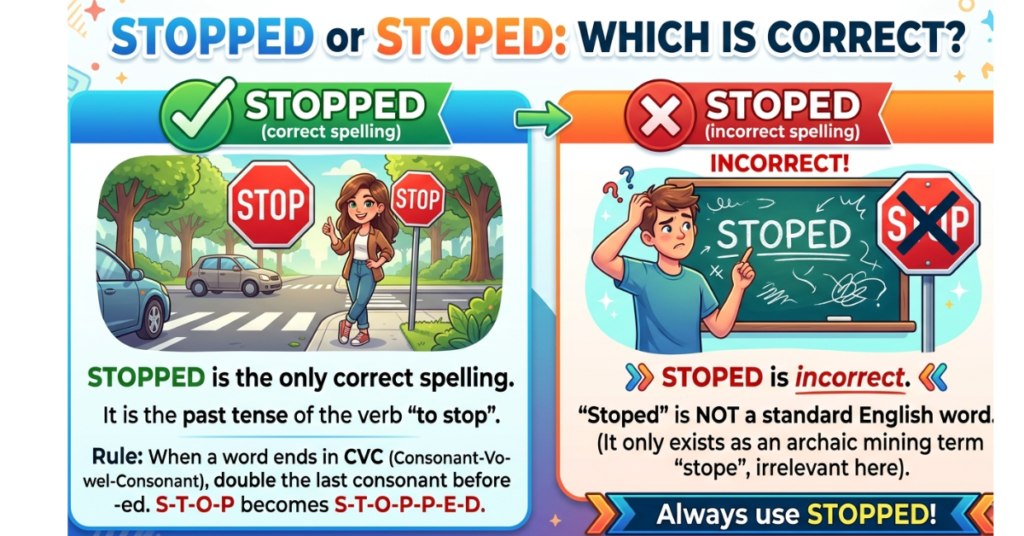
When choosing between stopped or stoped, the correct spelling is:
Stopped
Stoped (incorrect)
“Stopped” is the past tense and past participle of the verb stop.
Examples:
-
She stopped talking when the teacher entered.
-
The car stopped suddenly at the red light.
-
I stopped drinking coffee last year.
Why “Stopped” Is Correct Grammar Rule Explained
The Double Consonant Rule
The reason we write “stopped” instead of “stoped” comes down to a common spelling rule in English.
When Do We Double the Final Consonant?
You double the last consonant before adding -ed when:
-
The verb has one syllable
-
It ends in a consonant-vowel-consonant (CVC) pattern
-
The stress is on that single syllable
“Stop” fits perfectly:
-
S (consonant) + T (consonant) + O (vowel) + P (consonant)
-
One syllable
-
Ends in CVC pattern
So, we double the “p” → stopped
More Examples Like “Stopped”
Understanding similar words helps reinforce the rule.
Verbs That Follow the Same Pattern
-
Stop → Stopped
-
Plan → Planned
-
Drop → Dropped
-
Shop → Shopped
-
Tap → Tapped
Verbs That Do NOT Double the Consonant
-
Need → Needed (no doubling)
-
Look → Looked (no doubling)
-
Open → Opened (two syllables, no doubling)
Common Mistakes to Avoid
Even though the rule is simple, mistakes still happen. Here’s what to watch out for:
-
Writing “stoped” instead of “stopped”
-
Forgetting to double the consonant in similar verbs
-
Overcorrecting (e.g., “keeped” instead of “kept”)
Quick Tip:
If the word is short and punchy like “stop,” there’s a good chance you’ll need to double the final consonant.
Stopped vs Stoped in Everyday Writing
Why This Mistake Matters
Using the wrong spelling—like “stoped”—can:
-
Make your writing look unpolished
-
Affect academic or professional credibility
-
Confuse readers, especially in formal content
Quick Memory Trick
If you’re stuck choosing between stopped or stoped, remember this:
“Short word? Double the ending before -ed.”
It’s not perfect for every verb, but it works well for words like stop, drop, and plan.
FAQs
1. Is “stoped” ever correct?
No, “stoped” is always incorrect in standard English. The correct form is “stopped.”
2. Why do we double the “p” in stopped?
Because “stop” follows the consonant-vowel-consonant (CVC) pattern and is a one-syllable verb, so the final consonant is doubled before adding “-ed.”
3. Are there exceptions to the doubling rule?
Yes, especially with multi-syllable words. For example:
-
Prefer → Preferred (stress on last syllable, so double)
-
Visit → Visited (stress not on last syllable, so no doubling)
4. How can I avoid spelling mistakes like this?
-
Learn basic spelling rules (like CVC doubling)
-
Use spell check tools
-
Read more to build familiarity with correct forms
5. Is “stopped” used in all forms of English?
Yes, “stopped” is correct in both American and British English.
Conclusion
So, when it comes to “stopped or stoped,” the answer is clear: “stopped” is the only correct spelling. The double “p” isn’t random—it follows a consistent grammar rule that applies to many similar verbs.
Once you understand the pattern, you’ll start spotting it everywhere—and your writing will feel more confident and polished as a result.
If you’re working on improving your English, this is a great rule to master. Want to go further? Try learning other common spelling patterns and irregular verbs—they’ll make a noticeable difference.