

English spelling can sometimes feel like a puzzle. Words change form depending on tense, and small spelling mistakes can easily slip in. One common confusion people search online is “offerred or offered.” If you’ve ever paused while writing and wondered which one is correct, you’re not alone.
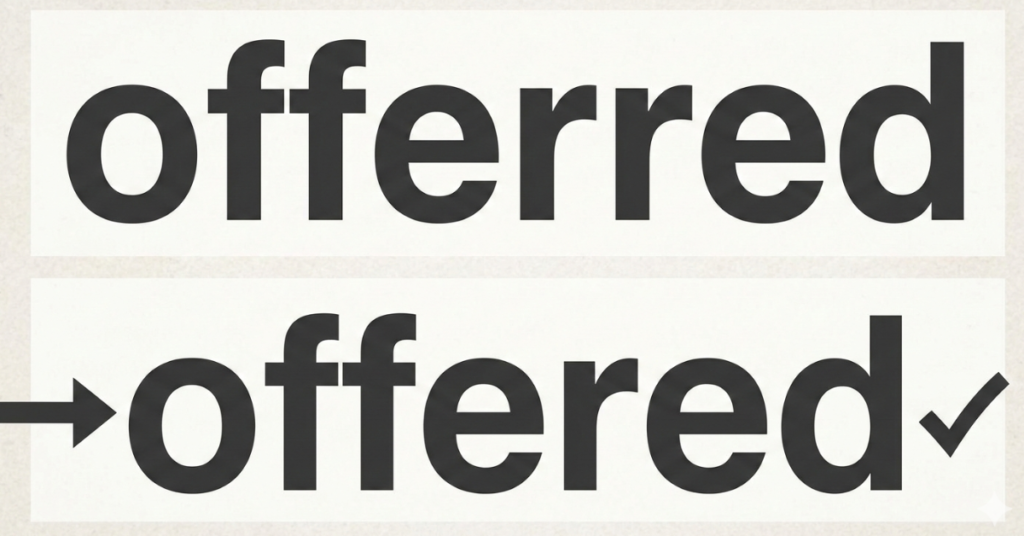
The short answer is simple: “offered” is the correct spelling, while “offerred” is a spelling mistake. The confusion usually comes from misunderstanding how English verbs change when forming the past tense.
In this article, we’ll break down the difference between offerred or offered, explain the grammar rule behind it, and provide examples so you can use the word confidently in emails, essays, and professional writing.
Understanding the Word “Offered”
Before diving deeper into offerred or offered, it helps to understand what the word actually means.
The word offered is the past tense and past participle of the verb “offer.” It describes the act of presenting something, proposing something, or making something available.
Simple Definition
Offer (verb): To present something for someone to accept or reject.
Example Sentences
-
She offered me a cup of coffee.
-
The company offered a new job opportunity.
-
They offered assistance during the difficult situation.
In each example, offered shows that the action happened in the past.
Offerred or Offered: The Correct Spelling
When comparing offerred or offered, the correct spelling is offered with one “r” and two “f’s.”
The spelling offerred is incorrect and not recognized in standard English dictionaries.
Quick Comparison
| Spelling | Correct? | Explanation |
| Offered | Correct | Past tense of “offer” |
| Offerred | Incorrect | Common spelling mistake |
If you’re writing professionally—whether in an email, article, or report—you should always use offered.
Why People Spell It “Offerred”
The confusion around offerred or offered usually comes from English spelling rules about doubling consonants.
Many verbs double the final consonant before adding -ed, such as:
-
prefer → preferred
-
refer → referred
-
occur → occurred
Because of this pattern, some people assume offer should follow the same rule and write offerred.
However, English spelling rules depend on syllable stress, which changes everything.
The Grammar Rule Behind Offered
The reason offered is spelled with a single “r” is because of syllable stress.
Key Rule
When adding -ed to a verb:
-
Double the final consonant only if the stress is on the last syllable.
Examples
| Word | Stress Pattern | Past Tense |
| prefer | pre-FER | preferred |
| refer | re-FER | referred |
| offer | OF-fer | offered |
Notice how offer has stress on the first syllable (OF-fer). Because of that, the “r” is not doubled, resulting in offered instead of offerred.
How to Use “Offered” Correctly
Now that we understand the difference between offerred or offered, let’s look at how the correct word is used in everyday writing.
1. In Professional Communication
Offered frequently appears in emails, job discussions, and business communication.
Examples:
-
The company offered me a competitive salary.
-
She offered valuable advice during the meeting.
-
Our team offered full support for the project.
2. In Academic Writing
Students and researchers also use offered when discussing ideas or proposals.
Examples:
-
The study offered new insights into climate change.
-
The professor offered additional resources for students.
3. In Everyday Conversation
Even in casual speech, offered appears frequently.
Examples:
-
He offered to drive me home.
-
They offered help when I needed it most.
Common Mistakes Related to “Offered”
Besides writing offerred, there are a few other common mistakes people make with the word.
1. Spelling Errors
Incorrect versions include:
-
offerred
-
offred
-
oferred
These mistakes often happen when typing quickly or relying on phonetic spelling.
2. Confusing Offer vs Offered
Some writers accidentally use the base verb instead of the past tense.
Incorrect:
-
She offer me a job yesterday.
Correct:
-
She offered me a job yesterday.
3. Misusing Verb Tenses
Sometimes writers mix verb tenses in a sentence.
Incorrect:
-
The company offers me a job last week.
Correct:
-
The company offered me a job last week.
Easy Tips to Remember the Correct Spelling
If you often hesitate between offerred or offered, these quick tips can help:
-
Offered has only one “r.”
-
The stress in offer is on the first syllable, so you don’t double the last letter.
-
Think of the phrase: “She offered help.”
Practicing with simple sentences will quickly make the correct spelling feel natural.
FAQs About Offerred or Offered
Is offerred ever correct?
No. Offerred is not a correct spelling in standard English. The proper past tense of offer is offered.
Why doesn’t offer double the “r” like preferred?
Because offer has stress on the first syllable (OF-fer). English spelling rules only double the final consonant when the stress is on the last syllable.
What is the meaning of offered?
Offered means that someone presented, proposed, or made something available in the past.
Example:
“The manager offered a promotion.”
Is offered a verb or adjective?
Primarily, offered is the past tense verb of “offer.” However, it can also function in passive constructions, such as:
“The help was offered immediately.”
How do you pronounce offered?
The correct pronunciation is “OFF-erd.” The stress falls on the first syllable.
Conclusion
When deciding between offerred or offered, the correct spelling is always offered. The word comes from the verb offer and follows English spelling rules that prevent doubling the final consonant when the stress is on the first syllable.
Understanding this small grammar rule can help you avoid a common mistake and improve the clarity of your writing. Whether you’re composing emails, academic papers, or blog posts, using offered correctly ensures your writing looks polished and professional.