

Have you ever stopped mid‑sentence and wondered whether you should write “eyeing” or “eying”? You’re not alone. English spelling can be tricky, especially when verbs change form. Many writers pause when adding –ing to the word “eye.”
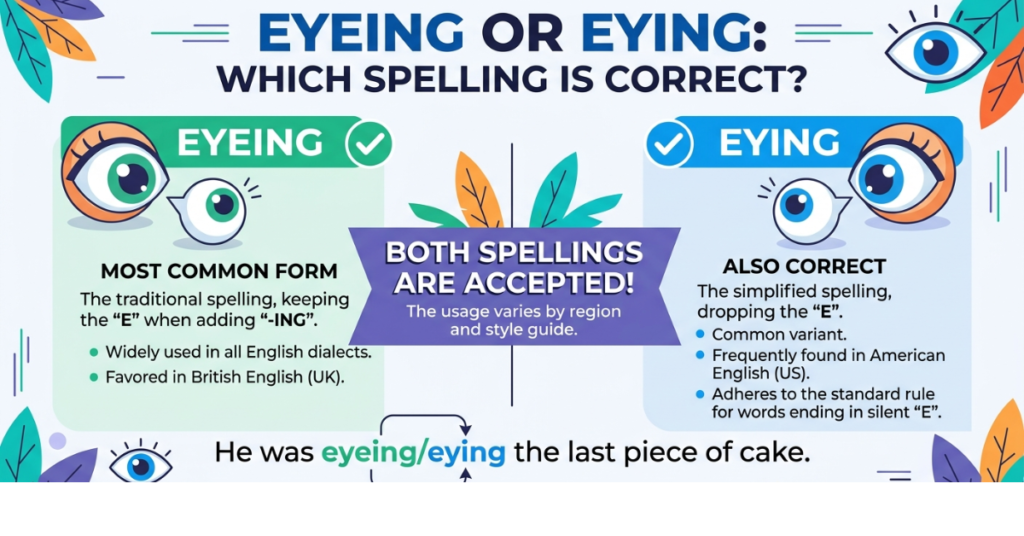
The truth is that both “eyeing” and “eying” are technically correct, but they aren’t used equally. In modern English, “eyeing” is far more common, especially in American and international writing. Understanding the difference between eyeing or eying can help you write more confidently and avoid confusion in professional or academic contexts.
In this guide, we’ll break down the spelling rules, usage examples, grammar explanations, and practical tips so you’ll always know which version to use.
What Does “Eyeing” or “Eying” Mean?
Both eyeing and eying are the present participle or gerund form of the verb “eye.”
To “eye” something means:
-
To look at something closely or carefully
-
To observe with interest, suspicion, or desire
-
To consider something thoughtfully
Simple Examples
-
She was eyeing the last slice of pizza.
-
The detective kept eyeing the suspect during questioning.
-
Investors are eyeing new opportunities in renewable energy.
In each case, the word describes looking at something with intention or interest.
Eyeing vs Eying: Which Spelling Is Correct?
When comparing eyeing vs eying, the key difference is frequency and style preference, not meaning.
1. Eyeing Most Common
“Eyeing” is the standard spelling used by most writers today.
It appears more often in:
-
News articles
-
Blogs and online content
-
Professional writing
-
American English publications
Examples:
-
The company is eyeing expansion into Asia.
-
Tourists were eyeing the historic building.
-
She kept eyeing the dessert menu.
Because it keeps the original word “eye” intact, many writers feel it looks more natural.
2. Eying Less Common but Still Correct
“Eying” is a simplified spelling that drops the extra “e.”
Some grammar systems prefer it because of the general rule: drop the final “e” before adding “-ing.”
Examples:
-
He was eying the clock during the meeting.
-
The cat was eying the bird on the fence.
However, this version appears less frequently in modern usage, which is why many editors recommend “eyeing.”
Why Two Spellings Exist
The confusion around eyeing or eying comes from competing English spelling rules.
Rule 1: Drop the Final “E”
Most verbs ending in e drop it when adding –ing.
Examples:
-
Make → Making
-
Write → Writing
-
Dance → Dancing
Following this rule gives us:
Eye → Eying
Rule 2: Preserve Clarity in Some Words
Sometimes the “e” is kept to maintain readability or pronunciation.
Because “eying” looks unusual, many writers prefer:
Eye → Eyeing
Language evolves through usage, and over time “eyeing” became the dominant form.
Eyeing vs Eying: Usage in Modern English
Corpus data and dictionaries show that “eyeing” is used significantly more often than “eying.”
Where You’ll See “Eyeing”
-
Journalism
-
Business news
-
Marketing content
-
Blogs and online media
Example headlines:
-
Tech Giants Eyeing AI Startups
-
Investors Eyeing Emerging Markets
Where “Eying” Might Appear
-
Some dictionaries
-
Older texts
-
Certain style guides
But overall, “eyeing” is the safer choice for most writing today.
Examples of “Eyeing” in Sentences
Here are several natural examples showing how eyeing is used in everyday writing.
Everyday situations
-
She was eyeing the cake but trying to stick to her diet.
-
The dog kept eyeing the food on the table.
Business or news contexts
-
The company is eyeing a merger with a rival firm.
-
Several startups are eyeing the electric vehicle market.
Suspicious or observant tone
-
Security guards were eyeing the crowd carefully.
-
He noticed someone eyeing his backpack on the train.
Common Mistakes When Using Eyeing or Eying
Writers sometimes make these small errors when dealing with this word.
1. Mixing Spellings in the Same Document
Choose one spelling and stick with it.
Example mistake:
-
The company is eyeing expansion while investors are eying new projects.
Consistency improves readability.
2. Confusing “Eyeing” with “I-ing”
Sometimes people mistakenly write:
I-ing the opportunity
The correct spelling is:
Eyeing the opportunity
3. Overthinking the Grammar Rule
While grammar rules matter, actual usage matters more. Since eyeing appears far more frequently in modern writing, it’s usually the better option.
Quick Rule to Remember
If you’re unsure whether to use eyeing or eying, follow this simple rule:
Use “eyeing.”
It is:
-
More widely accepted
-
Easier to read
-
Preferred in modern writing
Think of it as the default spelling.
Eyeing or Eying in American vs British English
Interestingly, both American and British English tend to favor “eyeing.”
Major dictionaries such as:
-
Merriam-Webster
-
Oxford English Dictionary
-
Cambridge Dictionary
recognize both spellings, but usage data shows eyeing dominates in real-world writing.
FAQs About Eyeing or Eying
Is “eying” a real word?
Yes. “Eying” is a correct spelling, though it is used less often than eyeing in modern English.
Which spelling is more common: eyeing or eying?
Eyeing is significantly more common in books, news articles, and online writing.
Should I use eyeing or eying in professional writing?
Most editors recommend eyeing because it is clearer and more widely recognized.
Why does “eyeing” keep the extra “e”?
The extra “e” helps maintain readability and keeps the original word “eye” visually recognizable.
Do dictionaries accept both spellings?
Yes. Major dictionaries list both “eyeing” and “eying.”
Conclusion
The debate between eyeing or eying comes down to spelling preference rather than meaning. Both forms are grammatically correct, but “eyeing” has become the dominant spelling in modern English.
If you want your writing to feel natural and widely accepted, “eyeing” is usually the safest choice. It appears more frequently in professional writing, journalism, and online content.
The next time you’re writing about someone eyeing an opportunity, eyeing a dessert, or eyeing a new business deal, you’ll know exactly which spelling works best.