
If you’ve ever scrolled through social media or overheard someone chatting about lifestyle vibes, you might have stumbled upon the terms “boujee” and “bougie.” While they sound similar—and are often used interchangeably—they carry slightly different connotations that are worth understanding. In this article, we’ll dive deep into boujee vs bougie, their meanings, cultural significance, and how to use them correctly.
What Does “Boujee” Mean?
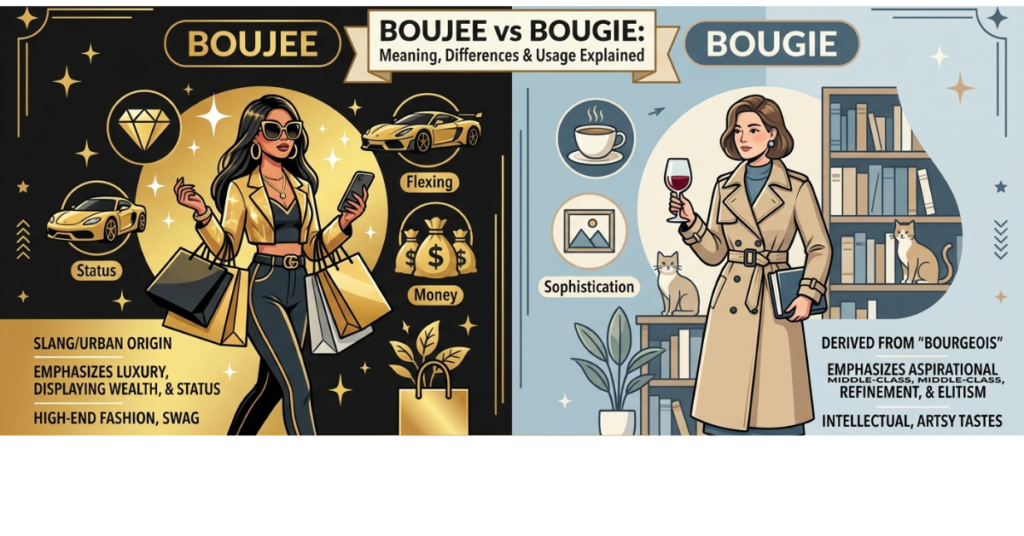
“Boujee” (pronounced boo-jee) is a slang term derived from bourgeois, referring to someone who enjoys a luxurious lifestyle but might come from modest beginnings. Think designer handbags, fancy brunches, and a love for high-end experiences.
Key points about boujee:
-
Often implies aspiration or indulgence in luxury
-
Can have a playful or flattering tone
-
Popularized by songs like “Bad and Boujee” by Migos
-
Trendy in pop culture and social media
Example sentence:
“She’s totally boujee—always sipping artisanal coffee and flaunting her new Chanel bag.”
What Does “Bougie” Mean?
“Bougie” (pronounced boo-gee) also stems from bourgeois, but it tends to carry a slightly mocking or critical tone. It’s often used to describe someone who is pretentiously middle-class, emphasizing refinement or materialism that might seem over the top.
Key points about bougie:
-
Can suggest snobbishness or elitism
-
Often used in a humorous or ironic way
-
Refers more to attitude than lifestyle
-
Commonly used in phrases like “acting bougie”
Example sentence:
“He brought his own sparkling water to the party—so bougie!”
Boujee vs Bougie: Side-by-Side Comparison
| Feature | Boujee | Bougie |
| Origin | Slang from bourgeois, pop culture | Slang from bourgeois, often ironic |
| Tone | Playful, aspirational | Slightly mocking, pretentious |
| Focus | Lifestyle, luxury, fashion | Attitude, behavior, social pretension |
| Example Usage | “She’s so boujee with her designer shoes.” | “He’s acting bougie bringing fancy snacks.” |
When to Use “Boujee”
Use boujee when describing someone who embraces luxury in a fun or aspirational way. This term is positive or neutral, perfect for:
-
Social media captions
-
Pop culture references
-
Conversations about fashion and lifestyle
When to Use “Bougie”
Use bougie when referencing someone who is being pretentiously refined, often with a touch of humor. This term is slightly critical or ironic, ideal for:
-
Describing behavior or attitudes
-
Light teasing among friends
-
Commenting on over-the-top social habits
Cultural Impact of Boujee and Bougie
Both terms reflect society’s fascination with wealth, style, and social status. They also highlight how language evolves with pop culture. Today:
-
Boujee is celebrated in music, Instagram, and celebrity culture.
-
Bougie has become a humorous shorthand for middle-class aspirations, often in memes and viral content.
FAQs About Boujee vs Bougie
Q1: Are boujee and bougie the same thing?
A: Not exactly. While both stem from “bourgeois,” boujee is aspirational and positive, while bougie is ironic or mocking.
Q2: Is bougie a bad word?
A: No, but it can carry a teasing or critical tone, depending on context.
Q3: Can I call myself boujee?
A: Absolutely! It’s often used as a fun self-description for someone who enjoys the finer things in life.
Q4: How do I pronounce boujee and bougie?
A: Boujee → boo-jee; Bougie → boo-gee.
Q5: Where did boujee come from?
A: Both words derive from bourgeois, a French term for the middle/upper class, but they evolved in slang culture differently.
Conclusion
Understanding boujee vs bougie isn’t just about spelling or pronunciation—it’s about grasping subtle differences in tone, context, and cultural nuance. Next time you want to describe someone’s lifestyle or attitude, you’ll know whether they’re luxuriously boujee or just a little bougie.