
Have you ever typed “insite” instead of “insight” and wondered if it was correct? You’re not alone. The confusion around insite or insight is incredibly common, especially because both words look similar and sound almost identical when spoken.
However, the truth is simple: “insight” is a real and widely used English word, while “insite” is usually a misspelling or a brand name. Understanding the difference can help you write more clearly, communicate professionally, and avoid embarrassing grammar mistakes.
In this guide, we’ll break down the meaning of insite vs insight, explain when each should be used, provide real-world examples, and help you remember the correct spelling going forward.
Insight Meaning: What Does “Insight” Mean?
Insight is a noun that refers to a deep understanding of a person, situation, or problem. It often implies a sudden realization or a clear perception of something that wasn’t obvious before.
Simple Definition
Insight:
A deep understanding or clear perception of something.
Examples of Insight in Sentences
-
Her research provided valuable insight into consumer behavior.
-
The therapist helped him gain insight into his emotions.
-
Data analytics can offer insight into market trends.
Common Contexts Where “Insight” Is Used
You’ll often see insight used in:
-
Business analysis
-
Psychology
-
Marketing
-
Personal development
-
Academic research
-
Data analytics
For example:
-
Market insights
-
Customer insights
-
Strategic insights
-
Personal insights
These phrases all refer to valuable understanding derived from analysis or experience.
Is “Insite” a Real Word?
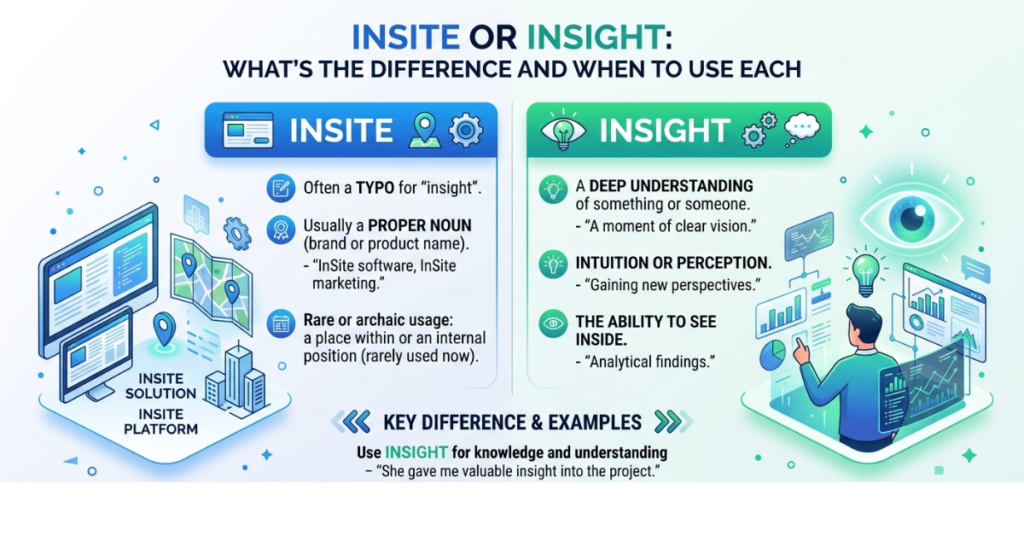
In most cases, “insite” is simply a misspelling of “insight.”
However, there are a few situations where Insite may appear legitimately:
1. Brand Names
Some companies use Insite as a brand name or product name. For example:
-
Software platforms
-
Marketing tools
-
Consulting companies
Example:
-
Insite Software (a company name)
2. Proper Nouns
Occasionally, Insite may appear as part of:
-
Business names
-
Product names
-
Website titles
-
Programs or initiatives
But in standard English writing, insight is the correct word.
Insite or Insight: The Key Differences
Here’s a simple comparison to remember the difference.
| Feature | Insight | Insite |
| Meaning | Deep understanding or perception | Usually a misspelling |
| Part of speech | Noun | Not standard English |
| Common usage | Writing, research, business | Brand names only |
| Correct spelling | Yes | Rarely |
Quick rule:
If you’re writing normally, you almost always want “insight.”
Why People Confuse Insite and Insight
The confusion between insite or insight happens for several reasons.
1. Similar Pronunciation
Both words sound nearly identical when spoken.
2. Typing Errors
Fast typing often leads to missing the “gh” in insight.
3. Autocorrect Issues
Sometimes autocorrect doesn’t flag insite, especially when used as a proper noun.
4. Brand Exposure
Because some companies use Insite as a brand name, people assume it’s a standard word.
How to Remember the Correct Spelling
A simple trick can help you avoid mixing up insite or insight.
Think of the Word “Sight”
The word insight contains “sight”, which relates to seeing clearly.
That’s helpful because insight means seeing something clearly in your mind.
Example:
-
In + sight = seeing into something
This mental connection makes the spelling easier to remember.
Synonyms for Insight
If you want variety in your writing, here are some useful alternatives for insight:
-
Understanding
-
Awareness
-
Perception
-
Wisdom
-
Knowledge
-
Clarity
-
Interpretation
Example:
Instead of saying:
The report provides valuable insight.
You could say:
The report provides valuable understanding of the issue.
Insight in Business and Marketing
The word insight is extremely important in business, especially in fields like marketing and analytics.
Common Business Terms
Businesses frequently use phrases such as:
-
Customer insights
-
Data insights
-
Market insights
-
Consumer insights
-
Actionable insights
Why Insights Matter
Insights help organizations:
-
Understand customer behavior
-
Improve marketing strategies
-
Make better decisions
-
Identify trends
-
Solve complex problems
For example:
A company might analyze purchasing patterns and gain insight into customer preferences, allowing them to design better products.
Insight vs Information
Another common confusion is the difference between information and insight.
| Information | Insight |
| Raw data or facts | Meaning derived from data |
| Numbers, statistics | Interpretation of those numbers |
| Surface-level | Deeper understanding |
Example:
-
Information: 70% of customers abandon carts.
-
Insight: High shipping costs are causing customers to abandon carts.
Insight turns data into understanding.
When You Should Use “Insight”
Use insight when you want to describe:
-
A deep realization
-
Analytical understanding
-
Knowledge gained from experience
-
Interpretation of data
Example sentences:
-
The book offers fascinating insight into human psychology.
-
Her experience gave her insight into leadership challenges.
-
The survey revealed insights about customer satisfaction.
Common Mistakes with Insight
Avoid these common grammar mistakes:
Incorrect:
-
The report provides great insite into the problem.
Correct:
-
The report provides great insight into the problem.
Incorrect:
-
We gained many marketing insites.
Correct:
-
We gained many marketing insights.
FAQs About Insite or Insight
1. Is “insite” ever correct?
In standard English writing, insite is usually incorrect. It may appear as a brand name or company name, but the correct word in most contexts is insight.
2. What does “insight” mean?
Insight means a deep understanding or clear perception of something, often gained through analysis, experience, or reflection.
3. Why do people write “insite” instead of “insight”?
People often confuse the words due to similar pronunciation, typing errors, and brand names that use “Insite.”
4. Is insight singular or plural?
-
Singular: Insight
-
Plural: Insights
Example:
-
The study revealed several important insights.
5. How do you use insight in a sentence?
Example sentences:
-
The article provides valuable insight into global economics.
-
Good leaders have insight into team dynamics.
Conclusion
Understanding the difference between insite or insight is simpler than it seems. In almost every writing situation, “insight” is the correct word, referring to a deep understanding or clear perception of something.
Meanwhile, “insite” is typically just a spelling mistake, unless it’s used as a brand or company name.
By remembering that insight contains the word “sight,” meaning to see clearly, you’ll never mix them up again. Whether you’re writing academic papers, business reports, or blog posts, using the correct word improves both clarity and professionalism.